Geometric flows in Mathematics and Physics (08w5110)
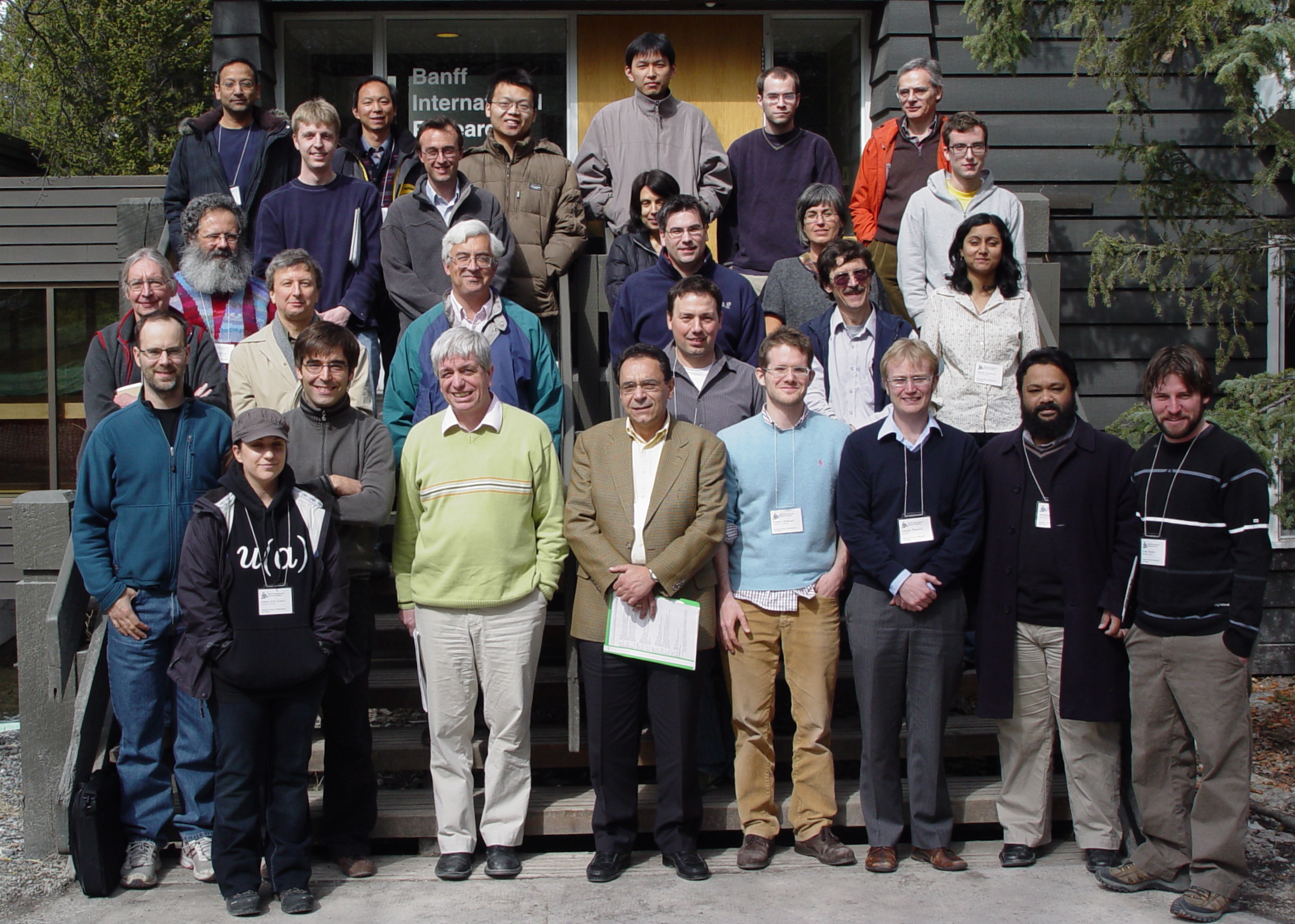
Organizers
Gerhard Huisken (Universitaet Tuebingen)
Todd Oliynyk (Monash University)
Eric Woolgar (University of Alberta)
Description
The Banff International Research Station will host top researchers in its workshop on "Geometric flows in Mathematics and Physics" next week, April 13 – 18, 2008. This workshop seeks to explore the connections between geometric flows and other areas of mathematics and physics. Geometric flows refer to various controlled ways in which geometry can be made to change smoothly with time, rather analogous to the way in which the geometry of the surface of a balloon becomes smooth and round as it is inflated with air. Over the last few years, this field has seen amazing mathematical progress, and the number of applications outside mathematics has increased dramatically as well. In this workshop, we will invite a wide spectrum of mathematical workers in the field, but we will also invite a roughly equal number of physicists working on applications of geometric flows in physics. Our hope is that by bringing these communities together, we will be able to facilitate the transfer of the most recent mathematical knowledge to those working on physical problems, while exposing mathematicians to physics problems to encourage and motivate further mathematical advances.
The Banff International Research Station for Mathematical Innovation and Discovery (BIRS) is a collaborative Canada-US-Mexico venture that provides an environment for creative interaction as well as the exchange of ideas, knowledge, and methods within the Mathematical Sciences, with related disciplines and with industry. The research station is located at The Banff Centre in Alberta and is supported by Canada's Natural Science and Engineering Research Council (NSERC), the US National Science Foundation (NSF), Alberta's Advanced Education and Technology, and Mexico's Consejo Nacional de Ciencia y Tecnología (CONACYT).