Harmonic Analysis in Convex Geometry (11w5034)
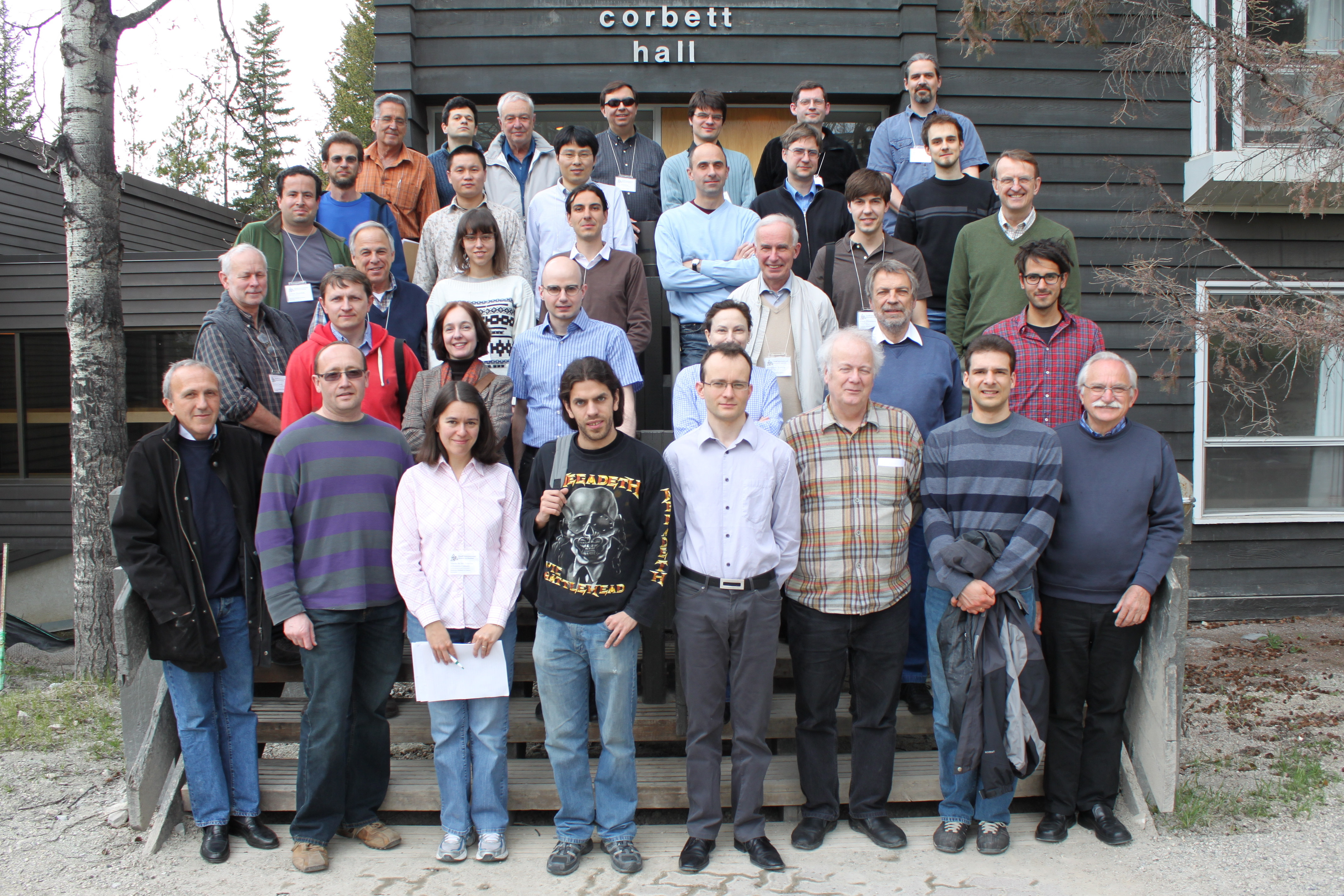
Organizers
Alexander Koldobsky (University of Missouri)
Dmitry Ryabogin (Kent State University)
Vladyslav Yaskin (University of Alberta)
Artem Zvavitch (Kent State University)
Objectives
The main goal of the proposed workshop at BIRS would be to invite the leading experts and young researchers in the area to coordinate the main applications of Harmonic Analysis to convex geometry and to develop new Fourier analytic approaches to the main open problems in the area.
The format of the meeting will be as follows. We are planning to have two to three plenary lectures every day followed by shorter talks. In addition we would like to allocate time for open problem sessions and informal discussions.
The proposed workshop will focus on several topics in Harmonic, Geometric and Functional Analysis. Fourier analytic methods proved useful in the study of sections and projections of convex bodies, volumes and surface area measures, embeddings of normed spaces in $L_p$ and other topics. Below we outline a few main directions of the workshop that represent research interests of the majority of the proposed participants.
1) Sections and projections of convex bodies.
The Busemann-Petty problem asks whether origin-symmetric convex bodies with smaller central hyperplane sections necessarily have smaller volume. Surprisingly, the answer to the problem is "Yes" in dimensions 2, 3 and 4, and "No" in higher dimensions. The problem was posed in 1956 and completely solved in mid-nineties. There are, however, modifications and generalizations of this problem that are still open. One of them is the lower dimensional Busemann-Petty problem, which asks the same question as the original Busemann-Petty problem but for sections of lower dimensions in place of hyperplanes. Another well-known open problem is the slicing problem, which asks whether any convex body of volume one has a large enough section (larger than a fixed constant independent of anything). We are also interested in non-central versions of the Busemann-Petty problem and the Shephard problem, which is the analogue of the Busemann-Petty problem for projections instead of sections.
2) Volume, polar body, Mahler conjecture and its functional versions.
The Mahler conjecture asks whether the product of the volume of an origin-symmetric convex body and the volume of its polar body is minimal in the case of the cube. Functional versions of this conjecture are also of great interest and are currently being studied by many people. In this context, of fundamental importance is the problem of finding possible connections, in terms of the Fourier transform, between the Minkowski norms of a body and its polar. Recently a new Fourier analytic approach towards the solution was found by Nazarov, who reformulated the conjecture into the following problem: how to construct an entire function (of several complex variables) that has value one at the origin, and such that its restriction onto $R^n$ has the smallest possible $L^2$ norm.
3) Classes of convex/star bodies associated with projections/sections. Relations between various classes. Geometric functional analysis.
Many of the problems discussed above are directly related to the study of certain classes of convex or star bodies. For example, intersection bodies played a key role in the understanding of the Busemann-Petty problem. Projection bodies are at the heart of the Shephard problem. The relation between Zhang's and Koldobsky's generalizations of intersection bodies stands behind the lower dimensional Busemann-Petty problem. Among open problems is the relation between polar projection bodies and intersection bodies, which is a key to understanding the duality between sections and projections of convex bodies. Such problems also have their interpretations in the language of functional analysis. In particular, many of the classes mentioned above can be described in terms of embeddings of normed spaces into $L_p$.
4) Tomographic results.
Here we include the problems of unique determination of convex bodies from lower dimensional data. In particular, the problem of Barker and Larman which asks whether convex bodies that contain a sphere of radius t in their interior are uniquely determined by the volumes of sections by hyperplanes tangent to the sphere. The problem is open even in the planar case. This circle of questions also includes various geometric transforms, their injectivity and their role in reconstruction of convex bodies from certain measurements.
5) $L_p$ Brunn-Minkowski theory.
In recent years a lot of interest has been drawn to the rapidly developing $L_p$ Brunn-Minkowski theory. The importance of the theory is evidenced by its applications to a variety of problems, including those discussed above. We will name a few directions that are being actively explored, among which are the $L_p$-Minkowski problem, $L_p$ affine surface areas, $L_p$ affine isoperimetric inequalities and others.
All these topics are being actively pursued at the present time and any progress in these directions will be a tremendous success of the workshop. We believe it is the right time for such a meeting to take place.