Organized tropical convection and large-scale circulation: Theory, modeling, and observations (11w5047)
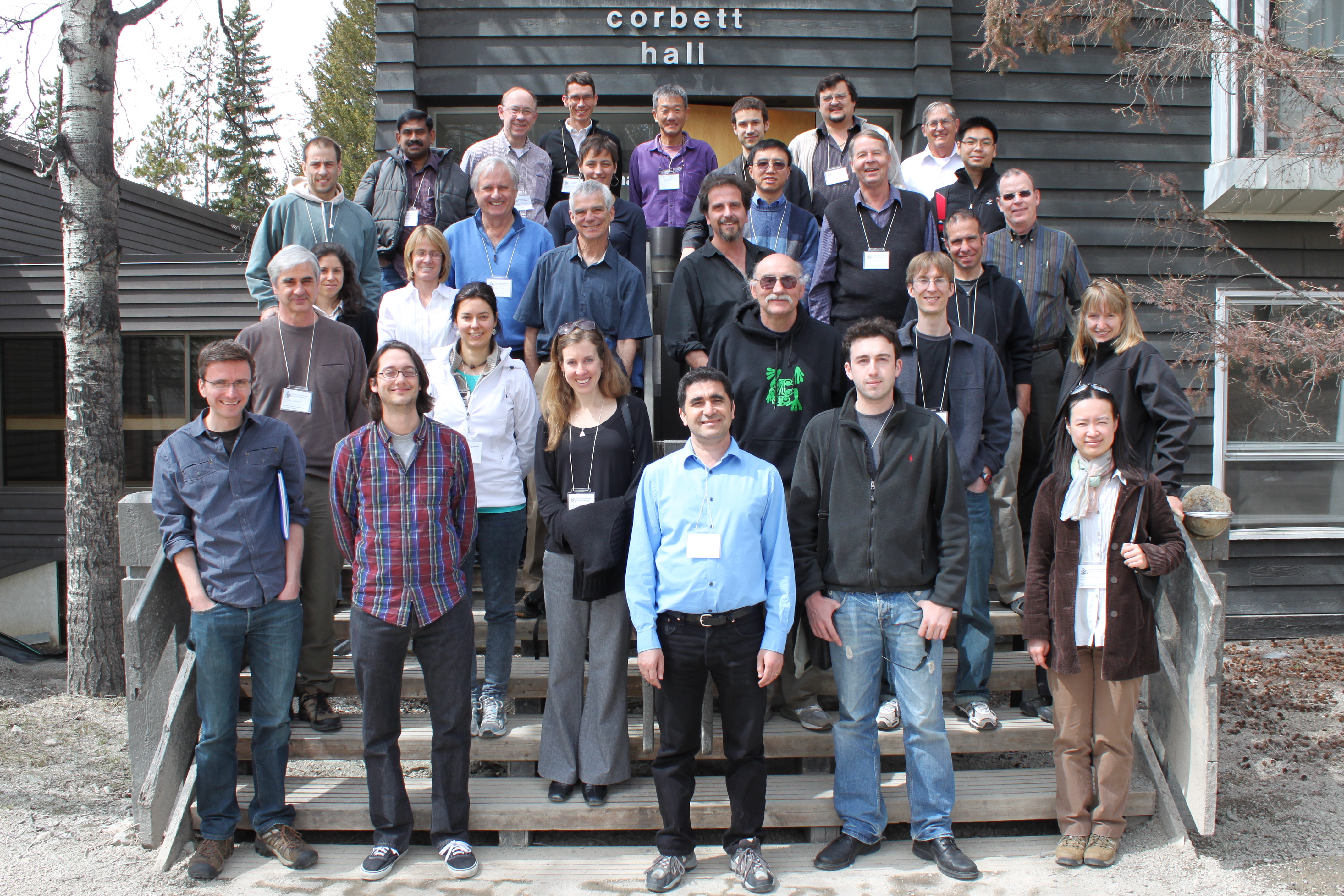
Organizers
Boualem Khouider (University of Victoria)
Andrew Majda (New York University)
Chidong Zhang (Pacific Merine Environmental Laboratory)
Description
The Banff International Research Station will host the "Organized tropical convection and large-scale circulation: Theory, modeling, and observations " workshop from May 1 to 6, 2011.
The tropical climate is characterized by dramatic variability affecting billions of lives, with sudden storms bringing heavy rainfall and floods or extended droughts resulting in crop failure. Recent developments have significantly improved our understanding of tropical atmosphere dynamics and the associated rainfall variability. It is now recognized in the scientific community that tropical climate is organized into a hierarchy of almost-periodic oscillations occurring on different time scales (from days through months to years), and embedded one in the other. On longer timescales lies the celebrated El Nino phenomenon, which repeats on timescales of 3-5 years. The dominant atmospheric signal is known as the Madden-Julian oscillation (MJO, in honor of its discoverers) with a period of 40-50 days. The MJO is characterized by a local rainfall increase and changes in wind strength and directions, as it propagates over Indonesia and across much of the Pacific Ocean. Moreover, it is now well established that the MJO affects the monsoon seasons as well as the mid-latitude weather and climate. In particular, severe floods in the North-West United States and British Columbia have been associated with individual MJO events. However, because of its complex nature, the inherent physics of the MJO are still not very well understood and today’s climate models are unable to predict it adequately.
University-based mathematicians and physicists together with scientists from operational climate modeling centers will be gathered in the Banff International Research Station to exchange ideas and look for solutions to the MJO problem.
The Banff International Research Station for Mathematical Innovation and Discovery (BIRS) is a collaborative Canada-US-Mexico venture that provides an environment for creative interaction as well as the exchange of ideas, knowledge, and methods within the Mathematical Sciences, with related disciplines and with industry. The research station is located at The Banff Centre in Alberta and is supported by Canada's Natural Science and Engineering Research Council (NSERC), the U.S. National Science Foundation (NSF), Alberta's Advanced Education and Technology, and Mexico's Consejo Nacional de Ciencia y Tecnología (CONACYT).