Twenty-five years of representation theory of quantum groups (11w5096)
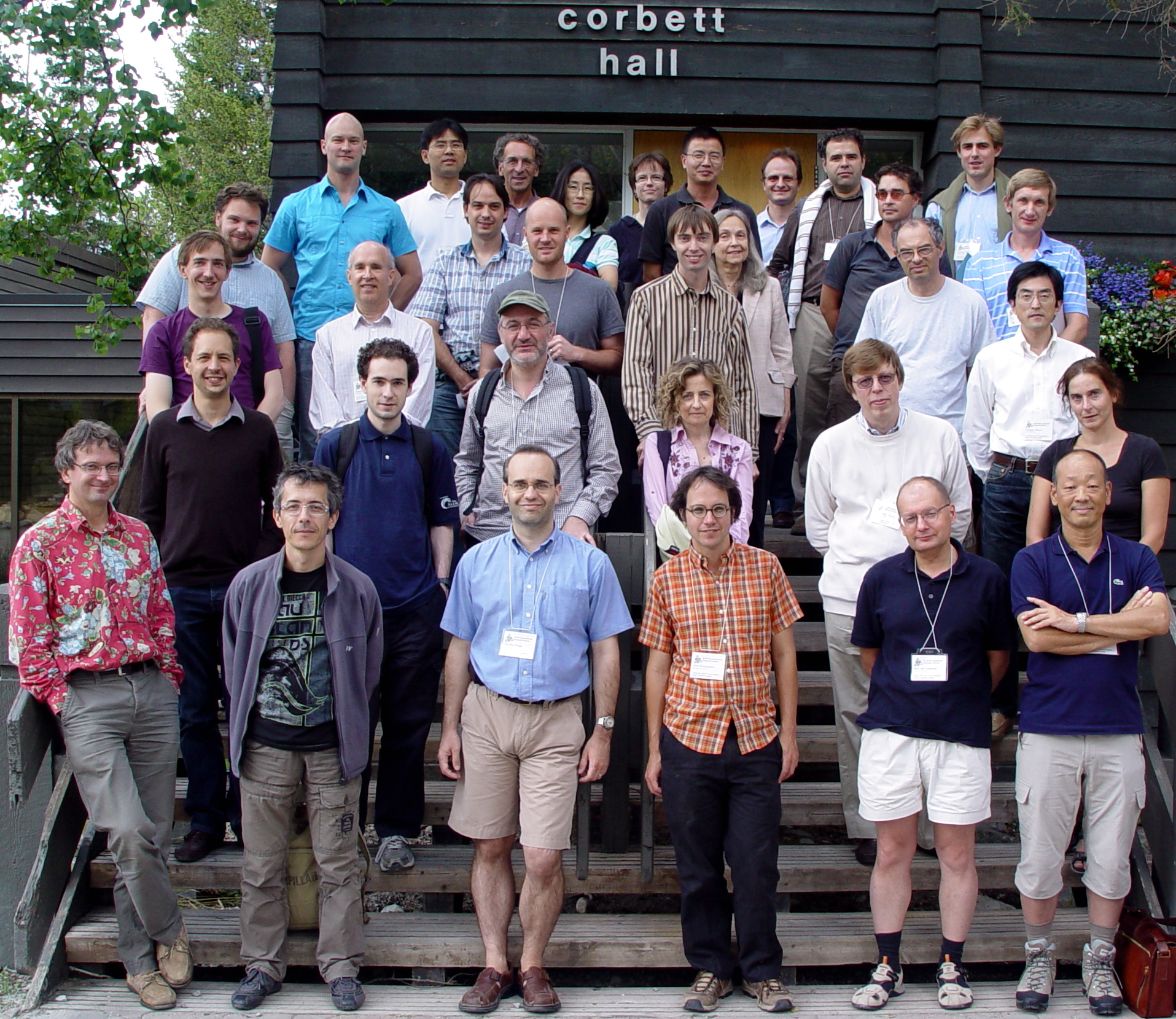
Organizers
Pavel Etingof (MIT)
Victor Ginzburg (University of Chicago)
Nicolas Guay (University of Alberta)
David Hernandez (Université Paris 7)
Alistair Savage (University of Ottawa)
Description
The Banff International Research Station will host the "Twenty-five years of representation theory of quantum groups" workshop from August 7th to August 12th, 2011.
Mathematics and physics have always been intertwined since Isaac Newton gave a mathematical formulation to his theory of gravitation in his treatise Principia Mathematica published in the XVIIe century. Since that time, mathematics has been extremely useful to study problems of a physical nature, but it is also true that a lot of mathematical discoveries have been inspired by physics: sometimes, concrete physical problems have motivated the quest for more sophisticated mathematical methods, other times, abstract ideas borrowed from physics have led to progress in mathematics. One field of mathematics which has been inspired by quantum mechanics is the theory of quantum groups.
The year 2011 marks the twenty-fifth anniversary of the address of V. Drinfeld at the International Congress of Mathematicians which launched this new branch of algebra. It will bring together world renowned experts on quantum groups along with younger mathematicians working in this field. The workshop will focus mostly on the representation theory of quantum groups, which is one of several facets of these mathematical objects. It will give the participants the opportunity to pave the way for future research in light of the progress made over the past twenty-five years and the recent discoveries of connections between representations of quantum groups and other mathematical objects of current interest.
The Banff International Research Station for Mathematical Innovation and Discovery (BIRS) is a collaborative Canada-US-Mexico venture that provides an environment for creative interaction as well as the exchange of ideas, knowledge, and methods within the Mathematical Sciences, with related disciplines and with industry. The research station is located at The Banff Centre in Alberta and is supported by Canada's Natural Science and Engineering Research Council (NSERC), the U.S. National Science Foundation (NSF), Alberta's Advanced Education and Technology, and Mexico's Consejo Nacional de Ciencia y Tecnología (CONACYT).