Advanced Mathematical Methods to Study Atmospheric Dynamical Processes and Predictability (11ss065)
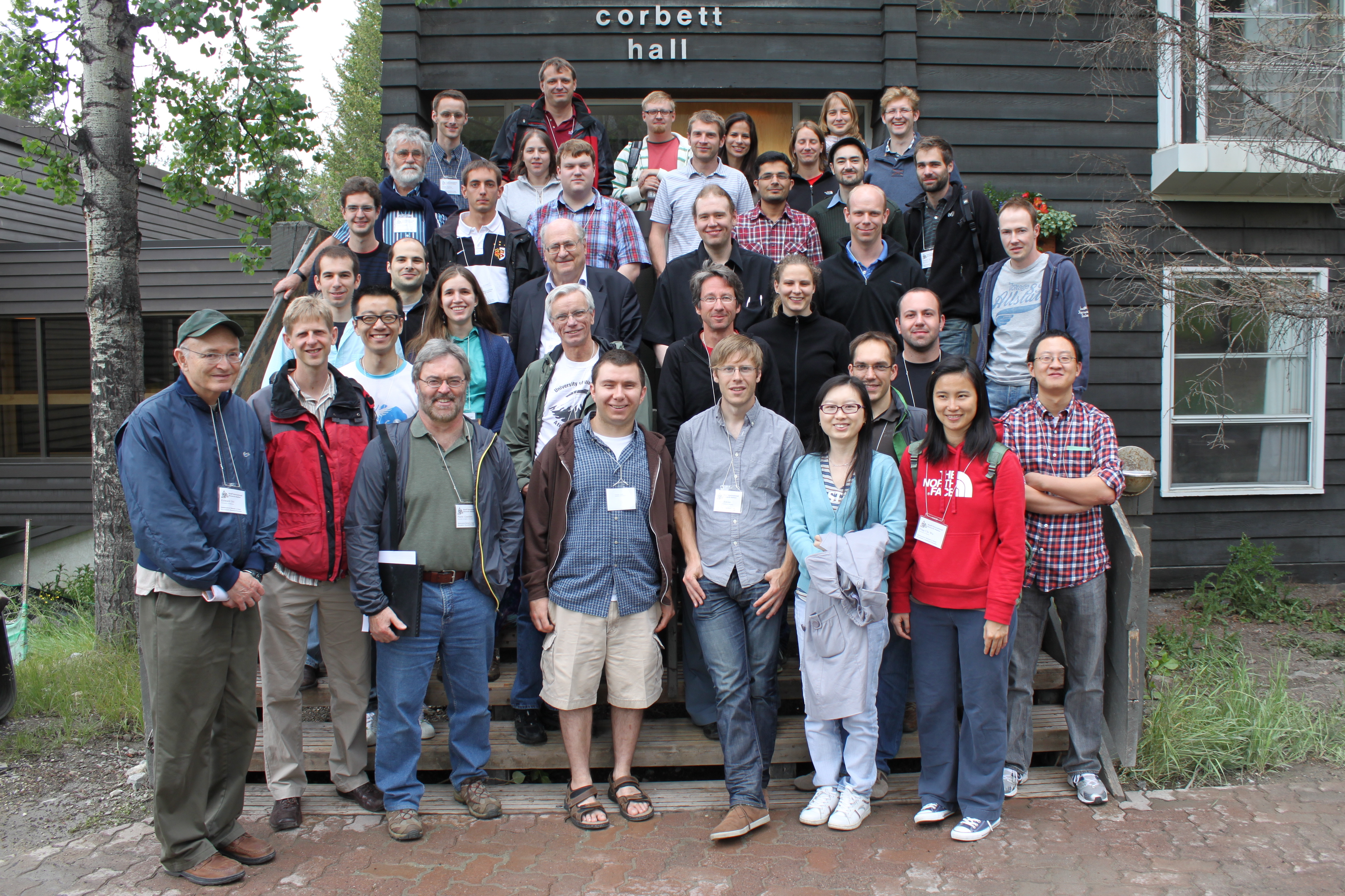
Organizers
Craig Bishop (Navy Research Laboratory Monterey)
Sarah Jones (University of Karlsruhe, Institute for Meteorology and Climatology)
Thomas Jung (European Centre for Medium-Range Weather Forecasts)
Istvan Szunyogh (Texas A & M University)
Olivier Talagrand (Laboratoire de Météorologie Dynamique )
Heini Wernli (ETH Zurich)
Description
The Banff International Research Station will host the "Advanced Mathematical Methods to Study Atmospheric Dynamical Processes and Predictability " workshop from July 10th to July 15th, 2011.
There is a long history of successful collaborations between mathematicians and atmospheric scientists on solving problems related to atmospheric dynamical processes and predictability. For instance, the meteorologist Edward Lorenz was the first to show how computer simulations can be used to explore the qualitative behavior of a dynamical system. His work made an important contribution to the emergence of a new subject field of mathematics, which now called dynamical systems. On the other hand, many scientists currently working on problems of atmospheric predictability, including those who design practical methods to quantify predictability, hold advanced academic degrees in mathematics.
The main objective of the proposed summer school is to expose young talents to a variety of advanced mathematical techniques that play an important role in the investigation of atmospheric dynamical processes and atmospheric predictability. Great emphasis will be placed on challenging open problems of the subject area. The program targets applied mathematics and atmospheric sciences graduate students. The workshop will be organized by members of the Predictability and Dynamical Processes (PDP) Working Group (WG) of the international weather research program THORPEX. The members of the PDP WG are all internationally recognized leading PDP experts who were appointed by the International Core Steering Committee of the program. Since THORPEX is an international program with active local research components on five continents, we expect to be able to identify talented young scientists to participate in the summer school from all around the world.
The Banff International Research Station for Mathematical Innovation and Discovery (BIRS) is a collaborative Canada-US-Mexico venture that provides an environment for creative interaction as well as the exchange of ideas, knowledge, and methods within the Mathematical Sciences, with related disciplines and with industry. The research station is located at The Banff Centre in Alberta and is supported by Canada's Natural Science and Engineering Research Council (NSERC), the U.S. National Science Foundation (NSF), Alberta's Advanced Education and Technology, and Mexico's Consejo Nacional de Ciencia y Tecnología (CONACYT).