Trends in Applied Harmonic Analysis (07w5022)
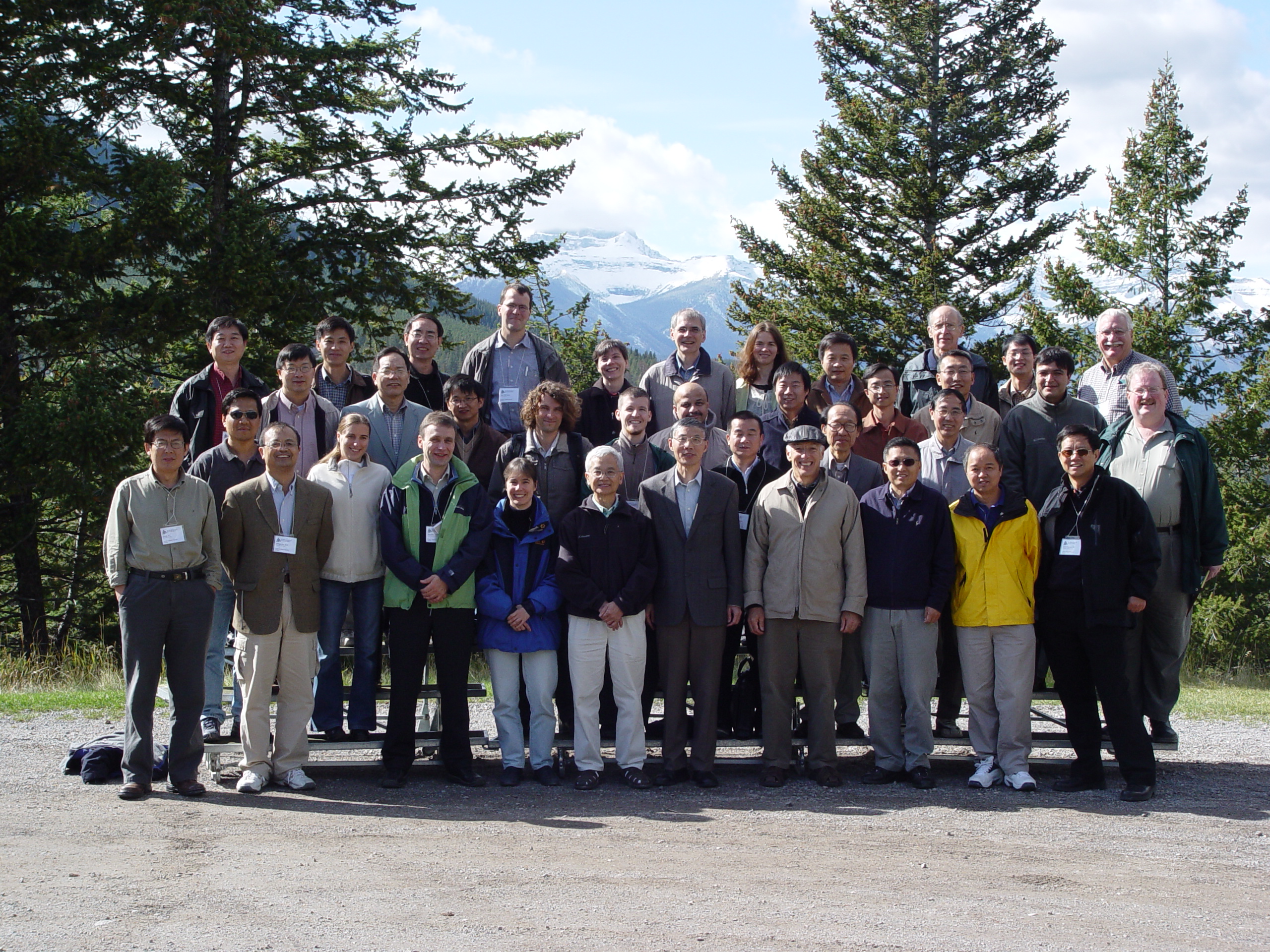
Organizers
Tony Chan (National Science Foundation)
Charles Chui (Stanford University)
Rong-Qing Jia (University of Alberta)
Objectives
There have been many exciting recent developments in Applied Harmonic Analysis, some of which are only at the beginning of various early stages. Interaction among leading experts and young researchers is necessary to invest in the future of this intra-disciplinary field. Maintaining a common link is also essential to facilitate the continuing successful joint ventures.
The last BIRS workshop on a similar topic took place in the summer of 2003 and was a great success. Since then, a lot has happened and new research areas have emerged. It is therefore believed that the year 2007 is the right time for the proposed workshop: to bring together leading experts to review the recent trends and to identify future directions. The objectives are to help create and maintain common links among the research communities related to Applied Harmonic Analysis, to promote further joint collaborations in this intra-disciplinary area, and to disseminate research findings for further advancement and identifying broader applications to
sciences and engineering.
The workshop will bring together first-rate senior experts from various areas of Applied Harmonic Analysis along with promising young researchers. It will emphasize on a combination of theoretical development with practical applications. The scope of the proposed workshop will be briefly described in the following. Although there are many success stories arising from this intra-disciplinary research field of Applied Harmonic Analysis, yet what is to be described below only marks the beginning of each development. The proposed workshop will therefore be important for achieving even greater success in Applied Harmonic Analysis and beyond.
(1) Wavelets, Approximation Theory, and Signal/Image Processing.
The notion of multi-resolution analysis (MRA), introduced in 1987 by Mallat and Meyer for the construction of wavelets and implementation of discrete wavelet transform (DWT) algorithms, has motivated the current advances of multi-level methods and multi-scale approaches in Applied Mathematics, as well as the recent development in Computer Graphics, in the area of curve and surface subdivisions. A canonical example is B-spline multi-resolution from Approximation theory. With wavelets, subdivision curves and surfaces have gained a powerful functionality for editing and rendering. On the other hand, the engineering fields of Signal and Image Processing have also gained an effective and efficient time-frequency localization tool from the advancement of wavelets. For instance, DWT has been adopted to replace the discrete cosine transform (DCT) in the JPEG image compression standard in the development of the more recent
industrial standard, called JPEG 2000 to add additional features, particularly in unifying lossy and lossless compressions, by eliminating the need of two different transforms, DCT and DPCM,
in the old JPEG standard.
(2) Learning Theory, Approximation Theory, and Statistics.
Another success story is the recent rapid advancement of Learning Theory, traditionally an engineering subject devoted to the study of unknown relations from statistical samples. Based on support vector machines and non-parametric estimation in Statistics, Learning Theory has broad applications to such areas as feature extraction, pattern recognition, neural networks, survival statistics, and data mining. However, although the statistical properties of learning algorithms in general are well understood, there have only been scattered results in the theoretical advancement of Learning Theory, till the recent introduction of a somewhat unified approach based on optimal recovery in Approximation Theory coupled with Probability Estimation, by Smale and others. In particular, for kernel machine learning, its formulation in terms of certain minimization problem leads to the application of the powerful tools from reproducing kernel Hilbert spaces.
(3) Variational Approach, Diffusion maps, and Diffusion wavelets.
Of course minimization of certain appropriate energy functionals is a common approach in formulating many mathematical models.
For instance, in Approximation Theory, minimization of the $L^2$-norm
of certain (partial) differential operations of an appropriate function
class leads to natural splines in 1-dimension and thin-plate splines
in higher dimensions. The same minimization of the $L^2$-norm of
the gradient operation of another function class gives rise to Gaussian
smoothing. More generally, when the square of the magnitude of the gradient
operation is replaced by a monotonic non-decreasing energy
functional, variational approach to solving the minimization problem gives
rise to the general model of anisotropic and total-variation diffusion
partial differential equations (PDE), adopted image analysis
to be discussed in more details next. When applied in the wavelet domain,
variational solutions extend the notion of wavelet thresholding introduced
by Donoho and Johnstone in the early 1990s. Moreover, the anisotropic
diffusion model, in turn, provides a key building block for the current
exciting development of diffusion maps and diffusion wavelets, introduced
by Coifman’s group at Yale. The key technique is application
of the Paley-Littlewood theory, again with strong Harmonic Analysis flavor.
It should be mentioned that this recent development provides a common link
to such interdisciplinary research areas as compression of scattered data
in high dimensions, dimension reduction, data mining, and Learning Theory.
(4) Mathematical Image Processing in Applied Harmonic Analysis.
One of the most successful intra-disciplinary research areas of
Applied Harmonic Analysis is Mathematical Image Processing (MIP)
in Image Science. The fundamental problem of MIP is to understand
the very nature of images, and develop their proper mathematical
descriptions or models, such as the classical Sobolev models,
Rudin-Osher-Fatemi's bounded variation (BV) model, and Mumford-Shah's
free-boundary model. This is a key to almost all image processing tasks
and schemes in the recent development. For example, under Statistical
Estimation Theory and variational optimization, wavelets based Besov
image models almost “diagonalize” important image processors
like image de-noising and compression. Through the prism of MIP,
these PDE-based methods have benefited from, as well as inspired,
powerful ideas in other approaches. For example, the multi-resolution
framework of wavelets has inspired nonlinear scale spaces generated
by anisotropic diffusion. Conversely, the geometric aspects of PDE methods
have spurred the integration of geometric concepts in Harmonic Analysis.
The use of Gabor and Besov space methods for textures has deep connections
with Meyer's dual BV norm. The use of total variation has inspired
new wavelet thresholding techniques for capturing sharp edges.
The two main challenges in contemporary MIP research are: firstly,
to further polish all the existing image models by incorporating
finer structures, as in Meyer's recent texture models built upon
some functional spaces of oscillatory patterns; and secondly,
to integrate and take advantage of the three major image processing
approaches: variational methods and their corresponding
geometric PDE models, Approximation Theory and Harmonic Analysis,
as well as Stochastic Modeling and Learning Theory.